




News





Knowledge





-
2025
Dec.Technology ApplicationHot Disk Addressing the Gap Between Thermal Simulation and Reality: The Critical Role of Material Characterization -
2024
Aug.Technology ApplicationHot Disk Using Hot Disk to Enhance EV Thermal Management Design and Coolant Selection -
2024
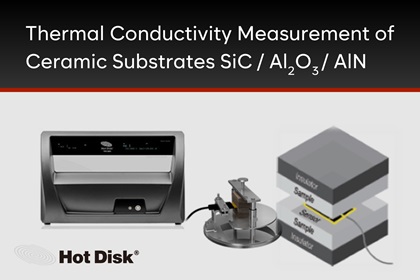
Jun.Technical InformationHot Disk Thermal Conductivity Measurement of Ceramic Substrates SiC, Al₂O₃, AlN -
2024
Jun.Technical PrinciplesHot Disk 5G Hot Business Opportunity: Challenges by Cooling Technology
Application
-
Thermal Conductivity
-
Thickness Guage
-
EPA
-
Element
-
X-RAY
-
Material
-
Restriction
-
Metal

-
Thermal Conductivity
A material’s ability to dissipate or insulate heat determines its range of applications. There are four common thermal properties: Thermal Conductivity, Thermal Diffusivity, Heat Capacity, and Specific Heat. -
Thickness Guage
Plastic, metal, and ceramic materials are often coated with metal, polymer, or oxide films to enhance aesthetics, wear resistance, electrical conductivity, corrosion resistance, and other properties. -
EPA
In industrialized regions around the world, industrial waste and wastewater, as well as emissions and dust generated by the petrochemical and metal recycling industries, can contribute to varying levels of heavy metal contamination in soil. -
Element
Elemental composition analysis can be used to identify the elemental composition of metals, determine the element ratios in glass and ceramic materials, and analyze the proportion of metal additives in polymers. -
X-RAY
Non-destructive X-ray inspection provides high-resolution 2D and 3D CT images without the need for disassembly. -
Material
Material physical and chemical property analysis provides insights into chemical structures, bonding, and unknown substances to evaluate microscopic structures and overall macroscopic properties. -
Restriction
Compliance with regulations such as RoHS 2.0 for restricted heavy metals and plasticizers, the WEEE Directive for electrical and electronic equipment recycling, the Consumer Product Safety Improvement Act (CPSIA), and EN 71 requirements for restricted substances in toys. -
Metal
The elemental concentrations in metal materials can be used to identify metal grades through Positive Material Identification (PMI) and determine whether their composition falls within acceptable ranges.